AI Doesn’t Fix Bad Data. It Acts on It.
In a recent post we made the case that AI can’t run what it can’t reach, and that getting your core systems into the cloud, with APIs and MCP, is the first real AI project for most small businesses. We also said access is only one of three prerequisites. This post is the second one: the data AI finds once it gets there.
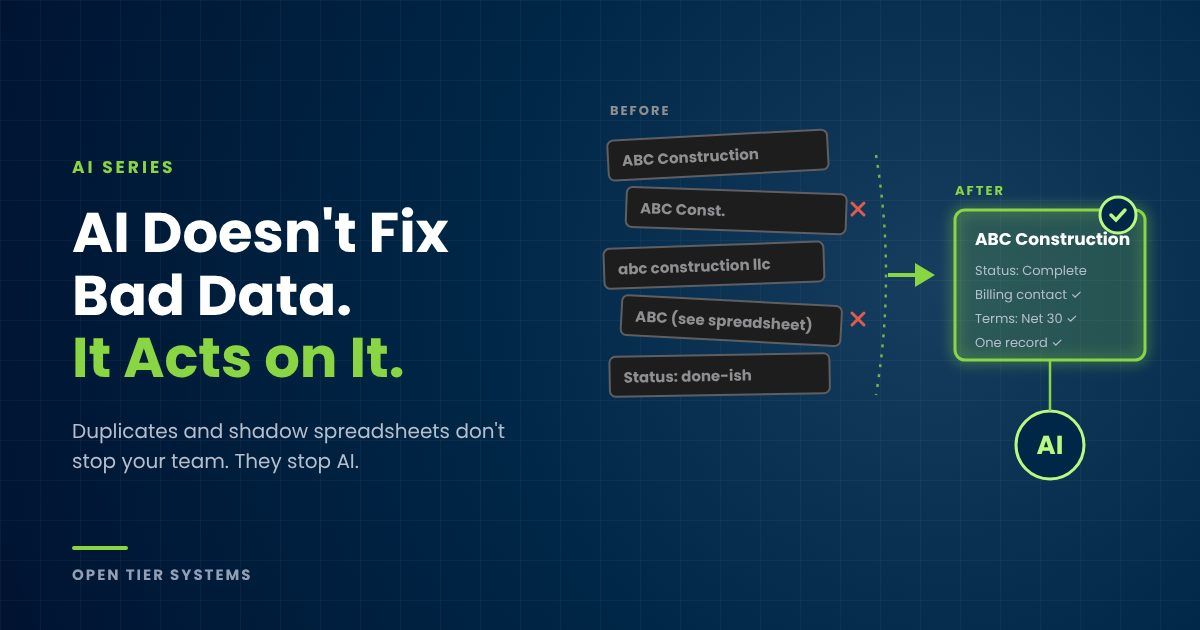
Here’s the uncomfortable part. AI doesn’t fix bad data. It acts on it, quickly and confidently, at a volume no person could match. Give an automation clean records and it’ll do in seconds what used to take an afternoon. Give it a mess and it’ll make mistakes in seconds that used to take an afternoon to make by hand.
What messy looks like in a real business
Nobody sets out to build a messy database. It happens one reasonable shortcut at a time, over years, by people who were busy doing actual work. Most small businesses we look at have some version of all of these:
Duplicates. The same customer exists as “ABC Construction,” “ABC Construction LLC,” and “ABC Const.” Each one has some of the invoices, some of the contacts, and some of the history. Ask which customers are most profitable and ABC shows up three times as a middling account instead of once as your best one.
Inconsistent naming. Job codes, project names, service types, and statuses that mean different things to different people. One person’s “complete” is another’s “waiting on punch list.” A human reading the record knows the difference. A report counting records doesn’t.
Free text doing a structured field’s job. The real payment terms, the real contact, the real reason a job is on hold, all typed into a notes field because the system didn’t have a better place for it or nobody bothered to use it. Useful to the person who wrote it. Close to invisible to anything else.
Stale records. Contacts who left their company two years ago. Vendors you stopped using. Open estimates nobody will ever follow up on. They don’t hurt anyone while a person is doing the work, because the person knows to skip them. An automation doesn’t know.
The shadow spreadsheet. The system of record says one thing, and the spreadsheet on the office manager’s desktop says what’s actually true. Every business has at least one. AI can only see the system.
Why your team copes and an automation won’t
Your people have been quietly correcting for all of this for years. They know which ABC is the real one. They know “complete” on Mike’s jobs means something different. They know to check the spreadsheet before calling a client about an overdue invoice. That knowledge is real, it’s valuable, and none of it lives in the data.
An automation working ten thousand records has none of it. It’ll send a past-due reminder for an invoice that was settled by a credit memo someone never applied. It’ll tell you a client is unprofitable because half their revenue is posted to a duplicate account. It’ll chase a contact who left the company in 2023. And it’ll do all of it without hesitation, because nothing in the data told it to hesitate.
The fix isn’t to keep AI away from your data. It’s to get the data to a state where the knowledge your team carries in their heads is written down in the system, where everything can use it.
What clean actually means
Clean doesn’t mean perfect. Chasing perfect is how data projects die. It means passing four tests on the data your automations actually touch:
One record per real thing. One customer, one record. One vendor, one record. Duplicates merged, with the history combined instead of deleted.
The same thing called the same way. Statuses, job types, service categories, and naming conventions pulled from a fixed list instead of typed freehand, and defined so everyone uses them the same way.
The fields that matter are actually filled in. If an automation needs a billing contact, an email, payment terms, and a project manager, every active record has them. Not most. Every.
One source of truth for each kind of data. Customer details live in the CRM, money lives in accounting, hours live in the PSA or job system, and everyone knows which system wins when two disagree. The shadow spreadsheet gets folded in or retired.
The cheapest moment you’ll ever get
If you’re moving off an on-premises system, and that post argued most businesses should be, the migration is the best chance you’ll get to clean house. The data has to be exported, mapped, and loaded anyway. Merging duplicates and standardizing fields on the way over costs a fraction of doing it later in a live system, and it means the new platform starts clean instead of inheriting ten years of shortcuts.
The worst version of a migration is a perfect copy of a messy database into a modern platform. You pay for the move and keep every problem.
Keeping it clean once it is
A one-time cleanup decays within a year unless something changes at the point of entry. A few rules do most of the work: required fields on the records automations depend on, dropdowns instead of free text wherever a fixed list will do, a named owner for each kind of data, and a quick review on a regular schedule.
This is also one place AI earns its keep early, safely. Flagging likely duplicates, records missing required fields, and contacts that haven’t been touched in two years is exactly the kind of tedious pattern-matching it’s good at. It suggests, a person approves, and the data gets better every week instead of worse.
Where we come in
Data hygiene is built into how we run AI Managed Services, because we’ve learned the hard way that skipping it is the fastest route to an automation nobody trusts. Our AI Business Assessment checks the data your highest-value automations will depend on, not just whether the systems can be reached. When a migration is part of the plan, cleanup happens on the way over. And once automations are live, hygiene checks run on a schedule as part of keeping them healthy.
Access gets AI into your systems. Clean data makes what it does there worth trusting. The third piece, governance, decides what it’s allowed to do at all. Early Access assessments are limited each quarter.
About The Author